A Bassus partbook copied on parchment from a set originally of five or six volumes. Albert 2019 demonstrates - relying on the original cover and flyleaves of this partbook - that it and the contratenor GB-Cu Dd.13.27 were compiled between 1523—5 in Rumburgh, Suffolk, for Launcelot Wharton, the prior of a small religious house there of no more than three members. The complexity of the pieces would therefore require external assistance to perform, indicating either that the books were simply a private collection or that, as Middleton-Stewart 2001 suggests (p. 175), they were used at nearby Mettingham College.

| Archive | St John's College, Cambridge, England (GB-Cjc) |
|---|---|
| Shelfmark | MS 234 (K.31) [Bassus] |
| Surface | Parchment |
| Numbering System | None / Unknown |
| Format | portrait |
| Measurements | 320 x 233 mm |
| Other Identifiers |
|
| Notations |
|
| Relationships |
|
| Provenance |
|
| Contents | Contains 37 compositions from 8 composers. |
General Description
Physical Description
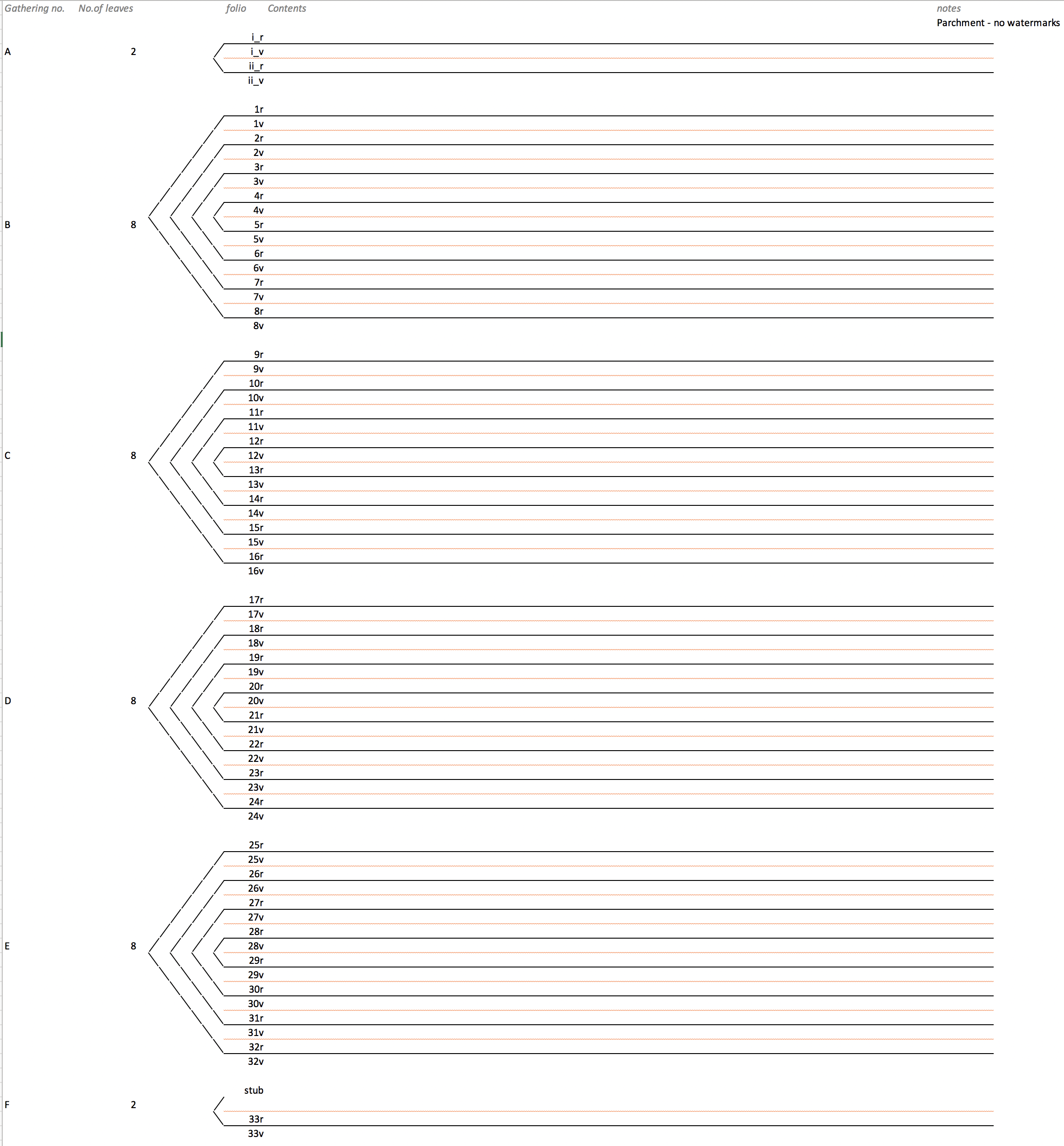
Gathering Diagrams click here to download excel file of these diagrams
Binding
Original limp vellum covers
Liminary Note
Inscription on cover: 'Launcelot Prior / Bassus.'
Notation
black void mensural
Foliation
No foliation or pagination.
Decoration
Red titles; initials in purple, green, red, and raised gold. Monograms on opening flyleaves: 'L', 'S', 'P'.
Surface
parchment
DIAMM Note
Digitized with funding from the Arts and Humanities Research Council (UK) for the Tudor Partbooks project at the Universities of Oxford and Newcastle.
Census Catalogue of Music Description
This information is reproduced here by kind permission of the publishers. It is COPYRIGHT and copying/reproduction of this content without permission may result in legal action.
5 Masses, 1 Magnificat, 1 Te Deum, 10 motets = 17
Ashwell-1, Aston-2, Davy-2, Fayrfax-6, Lovell-1, Pasche-1, Prowett-2, Taverner-2
1 parchment partbook of an original 5 or 6 (B-ii + 32 + i folios), 320 x 233; the tenor book is CambriU Dd. 13.27. No foliation or pagination. Original parchment covers. Red titles; initials in purple, green, red, and raised gold. Inscription on cover: "Launcelot Prior / Bassus." Monograms on opening flyleaves: "L", "S", "P".
Ca. 1525-30 (DaveyH). Copied in England.
19r
Loading inventory…
The inventory could not be loaded.
Sets
Select a set to see its sources.
'UJ' Partbooks
Partbooks · 2 sources
GB-Cjc MS 234 (K.31) [Bassus]
Current source
TUDOR PARTBOOKS
Project Collection · 170 sources
GB-Cjc MS 234 (K.31) [Bassus]
Current source
‡ denotes primary source study
Albert, Rachel. 2019. Finding the Functions of Music Books in England in the late 15th and early 16th Centuries: The Ritson MS and the Wharton Partbooks. University of Manchester, Ph.D. Pages: passim (111-2 for date & origins).
Middleton-Stewart, Judith. 2001 (rev. ed.). Inward Purity and Outward Splendour: Death and Remembrance in the Deanery of Dunwich, Suffolk, 1370-1547. Botdell Press. 9780851158204. Pages: 175. Notes: discusses performance possibilities for the music.
Curtis, Gareth R K, and Andrew B Wathey. 1994. Fifteenth-Century English Liturgical Music: A List of the Surviving Repertory. Royal Musical Association Research Chronicle, 27: 1-69.
Warren, Edwin B. 1969. Life and Works of Robert Fayrfax. Musicological Studies and Documents, vol. 22. American Institute of Musicology. Pages: 55. Notes: physical description; contents list; incipits of contents (partial).
Russell, Theodore C. 1967. Cantus Firmus Technique in the Music of Fifteenth Century Manuscripts of English Provenance. Student Musicologists at Minnesota, 2: 52-77. Pages: 65. Notes: concordances (partial).
Kirsch, Winfried. 1966. Die Quellen der mehrstimmigen Magnificat- und Te Deum-Vertonungen bis zur Mitte des 16. Jahrhunderts. Tutzing. Pages: 129. Notes: concordances (partial); incipits (partial).
Warrem, Edwin B (editor). 1959-66. Robert Fayrfax (ca. 1464-1521): Collected Works. Corpus mensurabilis musicae, vol. 17. Neuhausen nr. Stuttgart: American Institute of Musicology. Pages: I, i; II, 86ff; I, II, passim. Notes: concordances (partial); transcription (partial).
Stevens, Denis W. 1959. The Manuscript Edinburgh, National Library of Scotland, Adv. Ms. 5. 1. 15. Musica Disciplina, 13: 155-67. Pages: 161. Notes: concordances (partial).
Fellowes, Edmund H (editor). 1923-48. Tudor Church Music. London, Oxford et al. Pages: I, lx. Notes: physical description; contents list; incipits of contents (partial); transcription (partial).
Davey, Henry. 1921. History of English Music. London. Pages: 85-6. Notes: physical description; contents list; incipits of contents (partial).
James, Montague Rhodes. 1913. A Descriptive Catalogue of the Manuscripts in the Library of St John's College, Cambridge. Cambridge. Pages: 273-4. Notes: physical description; contents list.
Frere, Walter Howard. 1894-1932, repr. Hildesheim, 1967. Bibliotheca Musico-Liturgica: A Descriptive Handlist of the Musical and Latin-Liturgical Mss. of the Middle Ages Preserved in the Libraries of Great Britain and Ireland. 2 vols. London: The Plainsong and Medieval Music Society. Pages: II, 143, #929. Notes: physical description.
This form is used to make comments on a source. If you wish to notify us of a correction to the record, you should use the "Contribute a change" form instead.
No comments have been made.
Contributions to this record are recorded here. If you wish to contribute information or a correction to this record, use the "Contribute a Change" link. This will then be reviewed by DIAMM staff and, if accepted, your contribution will be acknowledged here.
Carlos Rodríguez Otero
Saturday, 29 July, 2023
Bibliography updated; link to Launcelot Wharton added; origins, provenance and dating updated. pp. 111-2 of Rachel Albert’s 2019 PhD, 'Finding the Functions of Music Books in England in the late 15th and early 16th Centuries: The Ritson MS and the Wharton Partbooks’ demonstrate that this partbook, and its Contratenor sibling in the Cambridge UL were compiled between 1523—5 in Rumburgh (Suffolk) for Launcelot Wharton, the prior of a small religious house there of no more than three members. All this is discernible from the John’s partbook only, as it has the original cover and flyleaves. Given the complexity of the works found in the books, and the forces required, Wharton would have needed external assistance to perform them. Perhaps, as Judith Middleton-Stewart suggests (Inward Purity and Outward Splendour, p.175) they were performed at Mettingham College. In any case, they are clear examples of a personal collection, and are a testament to music-making in smaller-scale religious houses before the Reformation did away with them.
Census-Catalogue of Manuscript Sources of Polyphonic Music 1400-1550
Monday, 23 January, 2017
NB: Migrated from old site. Credit for notes may not be completely accurate. Census Catalogue of Music Description