GB-Odiamm Virtual Reconstruction of the Lucca Choirbook (Strohm Codex) Virtual

DIAMM Virtual Manuscript Archive, Oxford, England

Reconstruction of dispersed fragments of a manuscript: Mid-15th century: ca. 1467-70, with additions c. 1485-1500

This is a virtual reconstruction assembled from selected pages of other physical sources. Its pages and inventory are independent snapshots with retained provenance links.
Archive DIAMM Virtual Manuscript Archive, Oxford, England (GB-Odiamm)
Shelfmark Virtual Reconstruction of the Lucca Choirbook (Strohm Codex)
Surface Parchment
Numbering System Foliation
Measurements 475 x 345 mm
Notations
  • black void mensural
Copyists
Relationships
Provenance
Contents Contains 69 compositions, 36 from 13 composers, 33 are anonymous.
General Description

Virtual reconstruction of the Lucca Choirbook, comprising folios (many of them bifolios) now held as Lucca MS 238, Pisa Cartella 11/III & Lucca MS 97.

The original manuscript was disassembled in the early 17th century; folios used as binding material. In 1963-4, Reinhard Strohm recovered 56 folios from bindings of archival registers in the Archivio di Stato at Lucca, and an additional bifolio at the Biblioteca Arcivescovile at Pisa. These form Lucca MS 238. The Pisa bifolio (= ff. 41/44 in Strohm’s reconstruction) is I-Plarc Cartella 11/III (or PisaBA s.s).

In 1976, Agostino Ziino and Strohm recovered, respectively, three and two additional folios at the Archivio di Stato in Lucca. Four of these bifolios are catalogued as I-Lcr MS 97.

Main scribe was a certain 'Waghes' (inscriptions on ff. 7, 15, 49'); later additions by three other scribes (StroMB). Main corpus probably copied in Bruges (StroMB). By 1472 at latest, manuscript given to Lucca Cathedral by Giovanni Arnolfini, a Lucca merchant doing business in Bruges. Used by cathedral's maestro di cappella, John Hothby; several pieces added, along with some texts and notes.

DIAMM, 2020
General Description

Note: the location (shelfmark) of a small number of folios is under investigation.

DIAMM, 2020
Binding

Preserved loose, as fascicles reflecting above foliation, in modern folder.

DIAMM, 2020
Ruling

10 staves per page; Width of rastrum: 18mm (measured on fol. 1)

DIAMM, 2020
Foliation

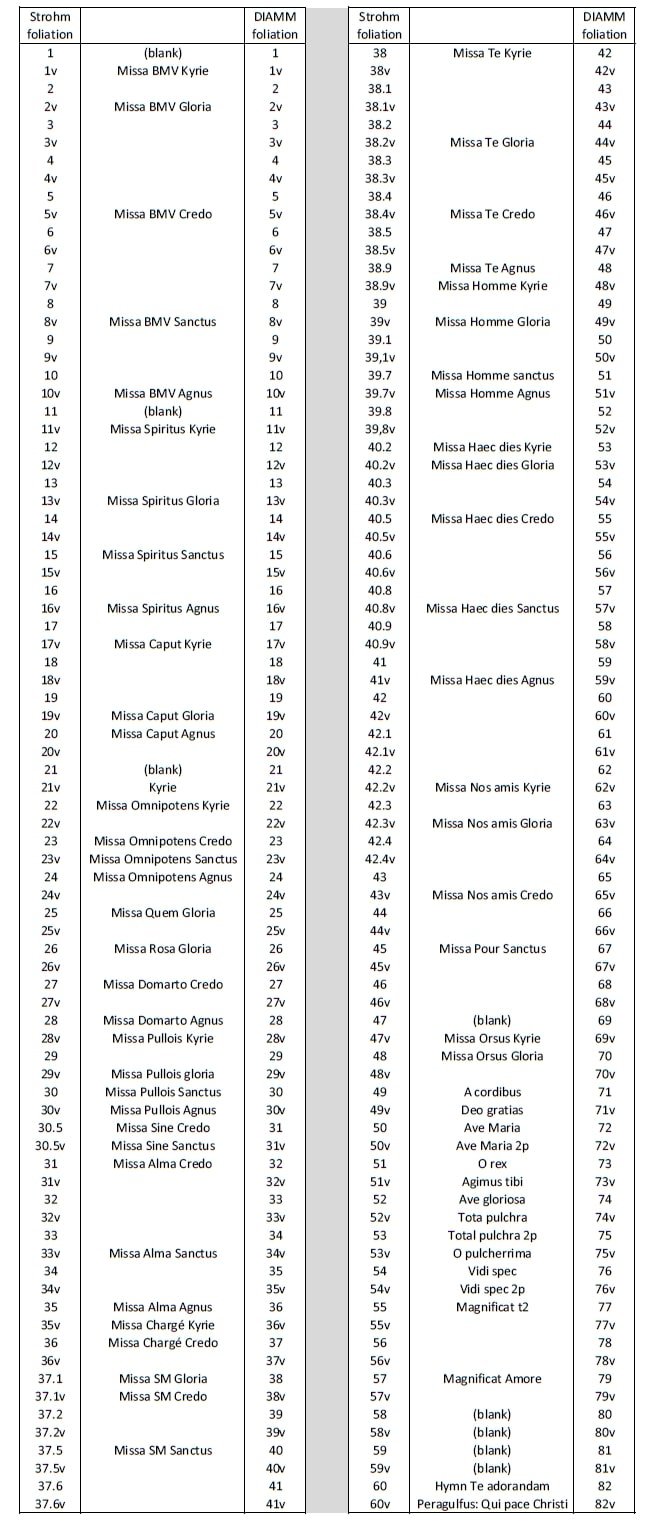
Strohm's modern foliation has been updated several times, interpolating new numbers in the 'original' modern foliation as additional leaves were found; with his facsimile of 2008 he completely reorganised the earlier foliation. However, while folios in gatherings 1-10 & 17-20 are numbered consecutively (apart from f. 30.5, the sole survivor of gathering 8), the folios in gatherings 11-16 are numbered with decimals to indicate the approximate placings within the gathering.

Strohm's final foliation, replacing earlier (1976) foliation: 1-30; 30.5; 31-36; 37.1-2, 37.5-6; 38, 38.1-5, 38.9; 39, 39.1, 39-7-8; 40.2-3, 40.5-6, 40.8-9; 41-42; 42.1-4; 43-60.

For this virtual representation of the manuscript, DIAMM has provided a new simplified listing, numbering each leaf consecutively in a continuous foliation 1-82. The chart below shows the cross-references to Strohm's foliation.

Strohm foliation

DIAMM, 2020
Decoration

Painted initials and inked calligraphic initials in blue, brownish-red, and gold.

DIAMM, 2020
Index

Modern index by Reinhard Strohm

DIAMM, 2020
DIAMM Note

For bibliography etc, see the entries for the sources: Lucca MS 97 and MS 238, and Pisa Cartella 11/III.

DIAMM, 2020
RISM Description

Catalogue entries for LucAS 238:

RISM B/IV 5: XVe s. 58ff. Parchemin, 460 x 340 mm. Foliotation moderne en haut des ff. Les ff. 11, 21, 35v, 48, 58r-v sont blancs. Lef. 1 coupé longitudinalement, le f. 11 très mutilé. Notation mesurée blanche. 10 portées par p. Six capitales enluminées or et coul., restes d'une miniature au f. 1v.

Dépecé au XVIIe s. pour servir de couvertures aux actes notariés des Archives, ce ms. reconstitué en 1965 à partir de feuillets épars, appartient au même groupe que les mss. de l'Estense à Modena (MOe 456) et de la Vaticana (Rvat. 51) copiés à la fin du XVe s. et avec lesquels il présente d'ailleurs quelques concordances (nos 2, 5b, 11, 13, 14). Il est possible qu'il ait été copié en Flandre vers 1470 et qu'il soit en relation avec l'évêque de Lucca Stefano Trenta (1448-1478) qui était nonce du pape en Angleterre et en Bourgogne sous Paul II dont on relève le nom plusieurs fois au f. 1. Le répertoire en tout cas, ne permet guère de repousser la date de la copie au delà de 1485. Malheureusement, aucune pièce n'est complète, mais le ms. a tout de même permis de découvrir l'auteur d'une messe restée jusque là anonyme dans TR89 (nos 736-740): Henricus Tik (no 1), ainsi qu'un Kyrie inconnu de Frye (no 4).

Le dépouillement suit la numérotation donnée par Strohm qui a découvert, mis en ordre et étudié le ms.

This information is reproduced here by kind permission of the publishers. It is COPYRIGHT and copying/reproduction of any of this content without permission may result in legal action.

DIAMM, 2020
Census Catalogue of Music Description

This information is reproduced here by kind permission of the publishers. It is COPYRIGHT and copying/reproduction of this content without permission may result in legal action.

17 Masses, 2 Magnificats, 9 motets = 28 (fragmentary and in-complete)

Domarto-1, (Dufay)-1 + 1?, Frye-1, (Heyns)-1, (Isaac)-1, (Martini)-1, (Plummer)-1, J.? Stone-1, Tik-1, anon-18

61 parchment folios, originally ca. 470 x 340. Once part of larger musical manuscript; two additional folios from same manuscript now PisaBA s.s. Modern (1976) foliation by Reinhard Strohm: 1-24; 24bis; 24ter; 25-30; 30bis; 31-40; 42-43; 45-46; 46bis; 47-48; 48bis; 49-58. Preserved loose, as fascicles reflecting above foliation, in modern folder. Modern index by Reinhard Strohm. Copied by one main scribe (Netherlandish hand), with several additions by later (Italian) hands. Painted initials and inked calligraphic initials in blue, brownish-red, and gold.

Ca. 1470, with additions ca. 1485-1500 (StroMB). Main corpus probably copied in Bruges (StroMB). By 1472 at latest, manuscript given to Lucca Cathedral by Giovanni Arnolfini, a Lucca merchant doing business in Bruges. Used by cathedral's maestro di cappella, John Hothby; several pieces added, along with some texts and notes. Original manuscript disassembled in early 17th century; folios used as binding material. In 1963-4, Reinhard Strohm recovered 56 folios from bindings of archival registers in the Archivio di Stato at Lucca, and an additional bifolio at the Biblioteca Arcivescovile at Pisa. In 1976, Agostino Ziino and Strohm recovered, respectively, three and two additional folios at the Archivio di Stato in Lucca. Bifolio discovered in Pisa (= ff. 41/44 in Strohm's reconstruction) is PisaBA s.s.

Vol. 3:

2 Masses (fragmentary) Anonymous

2 parchment folios, originally ca. 470 x 340, recovered by Reinhard Strohm from binding of archival register. Folios are from same original manuscript as LucAS 238. Strohm assigned single system of foliation to LucAS 238 and PisaBA s.s. in 1976; leaves at Pisa are f. 41 and f. 44.

Ca. 1470, with additions ca. 1485-1500. Main corpus of original manuscript probably copied in Bruges. See LucAS 238 for subsequent history, bibliography, and more detailed physical description.

Catalogue entries for LucAS 238:

Vol 4

Composers: Add "(Busnois?)-1" and "(Joye?)-2"; change "(Plummer)-1 " to "(Plummer)-1 + 1?"; change "anon-18" to "anon-14."

Physical: Main scribe was a certain "Waghes" (inscriptions on ff. 7, 15, 49'); later additions by three other scribes (StroMB).

Date: Ca. 1467-70 (main corpus), with additions from 1470's until ca. 1500 (StroMB).

DIAMM, 2020

(60v) I-La MS 238, 42v

Loading inventory…

The inventory could not be loaded.

This form is used to make comments on a source. If you wish to notify us of a correction to the record, you should use the "Contribute a change" form instead.

No comments have been made.

Contributions to this record are recorded here. If you wish to contribute information or a correction to this record, use the "Contribute a Change" link. This will then be reviewed by DIAMM staff and, if accepted, your contribution will be acknowledged here.

M. Jennifer Bloxam

Monday, 28 July, 2025

The 'O pulcherrima' at [75v] is the motet elsewhere identified in DIAMM as "O pulcherrima mulierum surge propera" and attributed (by Reinhard) to "Plummer, John (ca.1410-ca.1484) (?)."