
GB-Odiamm Virtual Reconstruction of Cambrai fragments (F-CA(n))

DIAMM Virtual Manuscript Archive, Oxford, England

Reconstruction of dispersed fragments from a single archive: 14th century

Archive DIAMM Virtual Manuscript Archive, Oxford, England (GB-Odiamm)
Shelfmark Virtual Reconstruction of Cambrai fragments (F-CA(n))
Surface Parchment
Numbering System Foliation
Measurements c300/310 x 220/235 mm
Notations
  • Ars Nova
Provenance
  • France
Contents Contains 26 compositions, 8 from 4 composers, 18 are anonymous.
General Description

Described by Lerch, following FallowsCA, and labelled by her F-CA(n) i.e. neu/new. It contains a number of otherwise unknown 14th century motets and mass movements, alongside some well-known ones.

A collection of pages, originally bifolios from a single 14th-century manuscript, which were re-used as guard pages in a number of different manuscripts & incunabula still held in the Cambrai collection. The largest group of fragments, held as MS B 1328, were removed and assembled into a portfolio prior to 1891; the remainder are still within the books where they were re-used: manuscript C647; and incunabula B56, B144, B145, B165, B166.

As well as the pastedowns, images include the 'mirror-image' offsets of the glued-down side of the fragments, which remained on the inside of the covers from which the fragments had been detached, sometimes in a more legible state than the fragments themselves.

The reconstruction of the surviving gatherings of the original manuscript fragments follows that in Lerch's thesis.
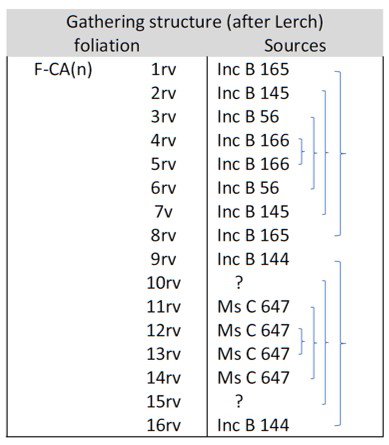
gatherings, after lerch

DIAMM, 2020
Physical Description

F-CA(n) itself has no physical existence.

As the pages which form the reconstruction were formerly glued into bindings as pastedowns, removing them left parts or all of the sides which were glued down almost illegible. Some, however, can be 'read' from their 'mirror images' left in the books from which they were removed - see FallowsCA.

DIAMM, 2020
Notation

Ars Nova

DIAMM, 2020
Ruling

Most folios have 8 five-line staves per page, in red or brown ink.

DIAMM, 2020
Foliation

1-16v, as described by Lerch. See MS B 1328 for a cross-reference between the various foliations used for the fragments which form part of that ms.

DIAMM, 2020
DIAMM Note

Pages from a number of manuscripts and incunabula are used in this reconstruction. Full information, bibliography, etc is provided in the entries on those sources.

DIAMM, 2020

(11v offset) F-CA MS C 647, front cover

Loading inventory…

The inventory could not be loaded.

denotes primary source study

Lerch, Irmgard. 1987. Fragmente aus Cambrai: Ein Beitrag zur Rekonstruktion einer Handschrift mit spätmittelalterlicher Polyphonie. Göttinger Musikwissenschaftliche Arbeiten, vol. 11. 2 vols. Kassel: Bärenreiter.

Fallows, David. 1976. L'origine du ms. 1328 de Cambrai. Revue de musicologie, 62: 275-80.

This form is used to make comments on a source. If you wish to notify us of a correction to the record, you should use the "Contribute a change" form instead.

No comments have been made.