A collection of pages from a number of different manuscripts, many removed from books and manuscripts where they were re-used as guard pages. The fragments were assembled into a portfolio prior to 1891; in 1967 the pages were cleaned and restored, and re-assembled. The most significant fragments are those which were part of a manuscript of motets and mass movements (described by Lerch) and others which were part of what "appears to be the earliest 14th century manuscript containing chansons" (Hasselman, p.25).
The RISM description has now been superseded in several respects: Fallows discovered several more related folios still bound into other volumes in the library; FallowsCA suggests that the volumes were bound at the end of the 15th century, probably for the new library of St Sepulchre erected by Guillaume Courtois, abbot 1482-1503). Additionally Fallows and Lerch were able to show that the fragments forming Lerch's 'series I' (which she labelled F-CA(n) - neu/new - collected here) were originally bifolios from a manuscript that was disassembled to re-use as guard pages, so that a partial reconstruction of the manuscript was possible (see Lerch). Further, locating the volumes from which the earlier fragments had been removed, Fallows found that 'mirror-image' offsets of the glued-down side of the fragments remained on the inside of the covers from which the fragments had been detached, often in a more legible state than the fragments themselves.
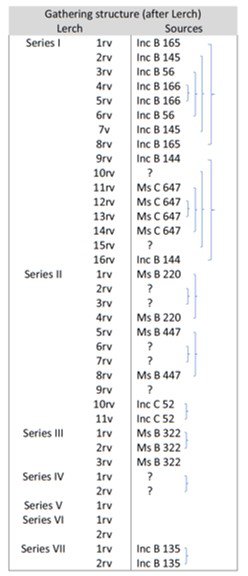
Related fragments used as binding materials, or their remaining 'mirror-image' offsets, are catalogued in the following incunabula: B56, B135, B144, B145, B165, B166, C52; and in the following manuscripts: B220, B322, B447, C647.
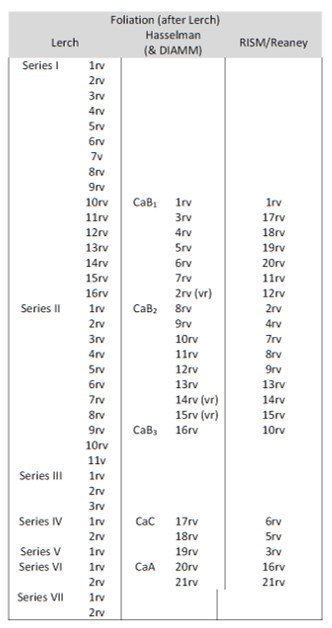
Hasselman, FallowsCA, and Lerch have all proposed different groupings and ordering of the folios. (See also 'foliation' below.) Hasselman identified 4 main groups of 14th century fragments, plus the fragments of Adam de la Halle and Gregorian chant. Lerch largely accepts her groupings, though re-assesses the first based on Fallows' discoveries. She groups the fragments into 7 series:
- I: "manuscript F-CA(n)", an expanded and re-ordered version of Hasselman's CaB1, containing motets and mass movements, and comprising 7 pages from this collection and 9 which remain in other books; a virtaul representation of this 'original' manuscript can be found at F-CA(n).
- II: a group of polyphonic chansons, Hasselman's CaB2 & CaB3 totalling 9 pages from this collection together with 2 newly-discovered pages from Inc C 52, probably from 2 (or more) different manuscripts;
- III: a small group of polyphonic songs which remain in Ms B322;
- IV: an Agnus and some chansons on 2 pages of this collection, Hasselman's CaC;
- V: 4 pieces by Adam de la Halle on one page in this collection;
- VI: 2 pages of Gregorian chant in this collection, Hasselman's CaA;
- VII: 2 pages of monophonic Trouvere songs located by Fallows in Inc B135
The DIAMM inventory of this collection therefore includes much of Lerch's series I and II, and all of series IV, V and VI; with the remainder being catalogued in the other books where the pages remain.